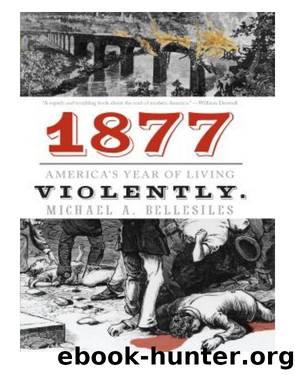
1877: America's Year of Living Violently: America's Year of Living Violently by Bellesiles Michael A
Author:Bellesiles, Michael A.
Language: eng
Format: epub
Publisher: The New Press
Published: 2010-08-16T16:00:00+00:00
Modern Policing in 1877
Police work in 1877 was a world away from CSI. There was little recognizable as solid policing or detective work, and little success in catching criminals unless they were apprehended on the spot. The police generally relied on brute force alone to get the job done; advanced methods followed the line suggested by Denver marshal David J. Cook as his first rule of good policing: “Never hit a prisoner over the head with your pistol, because you may afterwards want to use your weapon and find it disabled.”56
It was a time of tough police, men who did not hesitate to shoot to kill drunks who got out of hand, with coroners ruling such actions “justifiable homicide.” In St. Louis, Officer Jerry McCarty shot and killed a twenty-year-old vandal, John Shelley, as he fled. Father M.J. M’Cabe, a Catholic priest, testified to the shooting but justified the actions of Officer McCarty as “it was a matter of surprise to him that the officers had not killed one-half of the ‘Castle Garden’ neighborhood, as they mostly consisted of the vilest and lowest class of people, who are fighting and quarreling continually.” The jury agreed with the priest and acquitted McCarty. In Houston, an Officer Morris shot and killed a suspected horse thief, Andrew Washington, who was running away. Despite the overwhelming evidence that Washington was unarmed and running when Morris shot him in the back, the jury, which expected their police to use their guns, returned a verdict of not guilty.57 Sometimes, as George Sala observed, the press would abuse the police “for the addictedness of ‘clubbing’ people—that is to say, to brain them on slight provocation with their truncheons,” but generally there was little objection to more excessive violence. Sala personally witnessed a fight between police and a crowd of workers in New York in which the police drew their revolvers to hold off the crowd. Sala insisted it was clearly a friendly brawl, as the police “did not use those weapons; while on the part of the mob not a single shot was fired.”58
Curiously, developments in police procedure in New York were matched in Texas. In an effort to stem the rising tide of violence in Texas, Major John B. Jones, commander of the Rangers, and Adjutant General Steele compiled a written version of Byrnes’s Rogues’ Gallery. Their “Black Book,” or “Crime Book,” a copy of which was given to every Ranger, listed all the men wanted by the Rangers with as much description and other information as they could compile. The book attempted to bring some control to the wave of violence sweeping through Texas after the new Democratic legislature cut the Rangers’ budget by half. Responding to this crisis, Jones ordered his men in March 1877 to discontinue all operations against the Indians and shift their attention to crime. They found few allies as the Democratic-controlled courts tended to let white defendants walk free, no matter what their offense. The Rangers arrested hundreds of men
Download
This site does not store any files on its server. We only index and link to content provided by other sites. Please contact the content providers to delete copyright contents if any and email us, we'll remove relevant links or contents immediately.
| Africa | Americas |
| Arctic & Antarctica | Asia |
| Australia & Oceania | Europe |
| Middle East | Russia |
| United States | World |
| Ancient Civilizations | Military |
| Historical Study & Educational Resources |
In Cold Blood by Truman Capote(3384)
The Innovators: How a Group of Hackers, Geniuses, and Geeks Created the Digital Revolution by Walter Isaacson(3209)
Steve Jobs by Walter Isaacson(2899)
All the President's Men by Carl Bernstein & Bob Woodward(2378)
Lonely Planet New York City by Lonely Planet(2227)
And the Band Played On by Randy Shilts(2209)
The Room Where It Happened by John Bolton;(2159)
The Poisoner's Handbook by Deborah Blum(2141)
The Innovators by Walter Isaacson(2105)
The Murder of Marilyn Monroe by Jay Margolis(2098)
Lincoln by David Herbert Donald(1989)
Being George Washington by Beck Glenn(1977)
A Colony in a Nation by Chris Hayes(1935)
Under the Banner of Heaven: A Story of Violent Faith by Jon Krakauer(1806)
Amelia Earhart by Doris L. Rich(1696)
The Unsettlers by Mark Sundeen(1689)
Dirt by Bill Buford(1680)
Birdmen by Lawrence Goldstone(1668)
Zeitoun by Dave Eggers(1652)
